
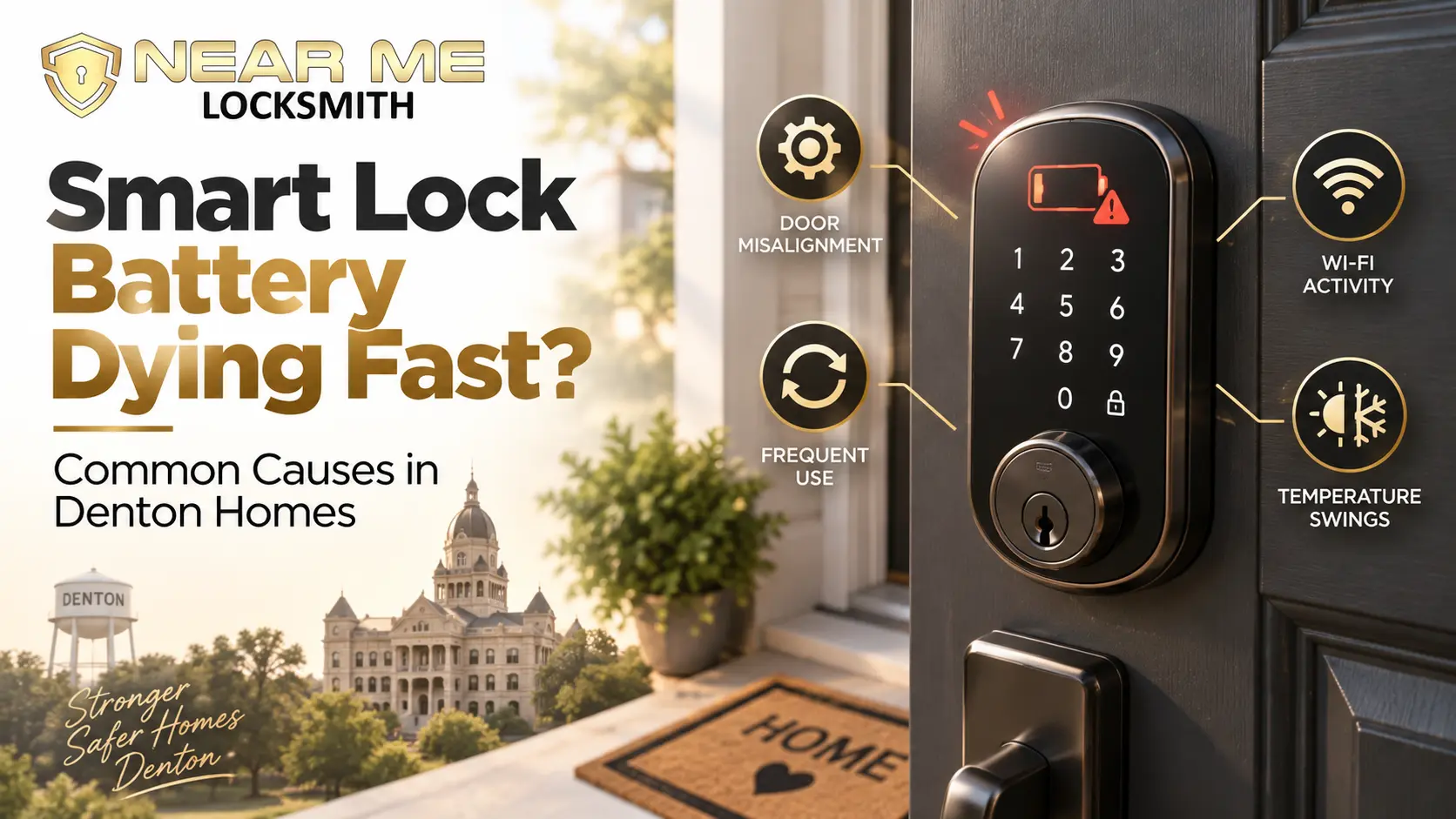
If your smart lock battery drains in days or weeks instead of lasting months, something’s putting extra load on the system. Most battery problems come from mechanical resistance, constant wireless activity, or temperature swings, not a defective lock.
Here’s what causes fast drain and how to fix it in Denton homes.
Common Causes of Fast Smart Lock Battery Drain
Smart locks fail prematurely when the motor works harder than it should or when wireless features run constantly. Here are the most common culprits we see:
Door Misalignment or Tight Deadbolt
When your door frame shifts, common in North Texas heat, the deadbolt meets extra resistance every time it locks or unlocks. The motor draws more power to overcome that friction, draining the battery much faster than normal. You’ll sometimes hear the motor strain or grind.
High Wireless Activity
If your lock checks Wi-Fi constantly, syncs with a hub every few minutes, or stays in pairing mode after setup, it never sleeps. Bluetooth models drain faster when multiple phones ping the lock throughout the day. Some locks also poll the network for firmware updates more often than needed.
Frequent Use Cycles
A lock that cycles 20 times a day uses more battery than one that cycles twice. If you have kids running in and out, constant deliveries, or auto-lock settings that re-lock every 30 seconds, you’re putting the motor through a lot of work. That’s not a defect just heavy use.
Extreme Temperature Swings
Denton summers hit over 100°F, and winter mornings can dip below freezing. Alkaline batteries lose capacity in cold and drain faster in heat. Locks installed on south or west-facing doors in full sun take the worst hit.
Weak or Mixed Batteries
Using partially drained batteries, mixing old and new batteries, or using off-brand alkaline cells shortens lifespan. Rechargeable NiMH batteries also deliver lower voltage and drain faster in high-draw devices like motorized locks.
How to Troubleshoot Battery Drain
Start with the mechanical stuff, it’s the easiest to rule out and causes most problems.
- Open and close your door manually. If it sticks or the deadbolt feels tight, adjust the strike plate or hinges.
- Test the lock with fresh, high-quality alkaline batteries from the same package. Don’t mix brands or charge levels.
- Turn off auto-lock temporarily and see if battery life improves. If it does, you’re cycling too often.
- Check your lock’s app settings for polling intervals, auto-update features, or constant connection modes. Disable what you don’t need.
- If your lock is in direct sun, consider a storm door or awning to reduce temperature extremes.
If none of that helps, the lock itself may have a defective motor or circuit board.
When to Call a Locksmith Instead of DIY
Most homeowners can swap batteries and adjust a strike plate. But if your door is warped, the frame is settling, or the lock still drains fast after troubleshooting, you need someone who installs smart locks regularly.
We’ve pulled locks that looked fine but had internal wear on the motor gears or corroded wiring. We’ve also found doors that needed shimming or deadbolts that were overtightened at installation. Those aren’t battery problems, they’re installation or alignment problems.
Don’t keep throwing batteries at a lock that needs adjustment. If you’re replacing batteries every two weeks, something’s wrong.
Should You Replace the Lock or Fix It?
If the lock is under warranty and you’ve only had it a few months, contact the manufacturer first. Most will replace a defective unit for free.
If the lock is several years old and you’ve already adjusted the door and tested new batteries, it might be time to upgrade. Motor components wear out, and older models don’t have the power efficiency of newer ones.
That said, don’t replace a lock just because it drains fast. Fix the door alignment first. We’ve seen people buy a new $250 lock when all they needed was a $40 lock adjustment.
Denton-Specific Factors
Denton’s clay soil causes foundation shifts, especially in older neighborhoods near the square and around Texas Woman’s University. If your home is settling, your door frame may be out of square, adding friction to every lock cycle.
We also see a lot of battery drain on locks installed on metal security doors or doors with heavy insulation. The extra weight and tighter seals create resistance the motor has to overcome.
FAQ: Smart Lock Battery Drain in Denton
How long should a smart lock battery last?
Most smart locks last 6–12 months on fresh alkaline batteries with normal use. If yours drains in under 3 months, something’s wrong.
Can I use rechargeable batteries in my smart lock?
You can, but they drain faster because they deliver lower voltage. Stick with alkaline unless the manufacturer specifically recommends rechargeable.
Will turning off Wi-Fi save battery?
Yes. If your lock supports offline operation, disabling Wi-Fi or reducing polling frequency can double battery life.
Does auto-lock drain the battery faster?
Absolutely. Every lock cycle uses power. If your lock re-locks every 30 seconds because someone keeps opening and closing the door, you’re cycling dozens of extra times per day.
Ready to get started in Denton?
Near Me Locksmith, LLC is here to help with smart lock battery dying fast Denton in Denton. Reach out today and we’ll walk you through your options, answer your questions, and book a time that works for you.
Call (469) 252-1756 or visit Near Me Locksmith, LLC to schedule your Denton appointment.