
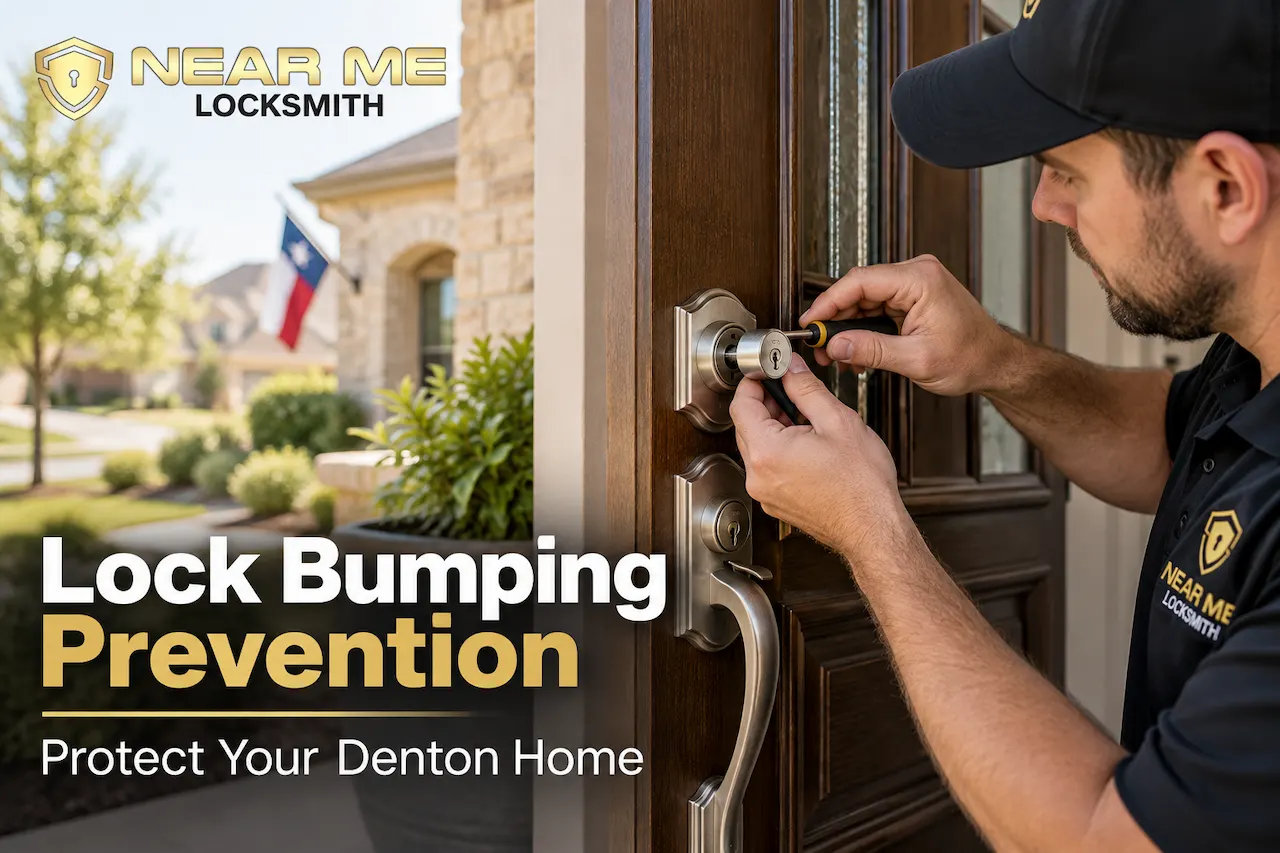
Lock bumping is one of the sneakiest ways burglars get inside homes without leaving obvious signs of forced entry. If you’ve got standard pin-tumbler locks on your doors and most homes in Denton do they’re vulnerable to this technique. The good news? A few smart upgrades can shut down this threat completely.
Here’s what you actually need to know about lock bumping prevention and how to secure your home.
What Is Lock Bumping and How Does It Work?
Lock bumping uses a specially cut “bump key” that fits into a standard pin-tumbler lock. The intruder inserts the key, taps it with a hammer or screwdriver, and the pins jump just long enough for the lock to turn. It takes about 10 seconds if they know what they’re doing.
The reason it works is that most residential deadbolts and doorknob locks use the same basic pin-tumbler mechanism. A bump key is filed down so it can manipulate those pins all at once. No picking required.
I’ve seen homeowners who thought they were locked out but had no visible damage to the lock and it turned out someone had bumped it days earlier. That’s the scary part: no broken glass, no pry marks, no evidence.
Which Locks Are Most Vulnerable to Bumping?
Not all locks can be bumped, but the most common residential locks are sitting ducks.
High-Risk Locks
- Standard Kwikset and Schlage pin-tumbler deadbolts
- Builder-grade doorknob locks
- Any lock that accepts a traditional brass key without special grooves or dimples
- Older mortise locks without anti-bump pins
Bump-Resistant or Immune Locks
- Medeco high-security deadbolts with rotating pins
- Mul-T-Lock cylinders with telescoping pins
- Abloy disc-detainer locks
- Electronic and smart locks with no keyway
- Locks with spool pins, mushroom pins, or serrated pins designed to resist manipulation
If you’re not sure what you have installed, pull out your key and look at the cuts. If it’s a simple up-and-down pattern, you’ve probably got a bumpable lock.
Practical Lock Bumping Prevention Steps
You don’t need to replace every lock in your house tomorrow, but you should prioritize your main entry points — front door, back door, and garage entry.
Upgrade to High-Security Deadbolts
The single best defense is swapping your current deadbolt for a high-security lock with bump-resistant pins. Medeco, Mul-T-Lock, and Assa Abloy all make residential models. These aren’t cheap expect $150–$300 per lock installed — but they’re nearly impossible to bump.
Add Anti-Bump Pins to Existing Locks
If you’re on a budget, we can rekey your current deadbolt and replace the standard pins with spool or mushroom pins. It’s not foolproof, but it makes bumping much harder. Costs around $40–$60 per lock.
Install a Keyless Entry System
No keyway, no bumping. Electronic keypads and smart locks eliminate the problem entirely. You’ll still want a backup mechanical lock, but making it your secondary option reduces risk.
Use a Security Bar or Door Reinforcement
Even if someone bumps your lock open, a security bar, floor brace, or reinforced strike plate can stop the door from opening. These work great for sliding doors and inward-swinging entry doors.
Check Your Locks Regularly
If your key suddenly feels loose or the lock turns too easily, something might be wrong. Bump attacks can damage the pins over time, leaving the lock easier to manipulate. We’ve caught a few cases where homeowners didn’t realize their lock had been tampered with until we inspected it during a lock change.
Frequently Asked Questions
Can I tell if my lock has been bumped?
Usually not. Bump attacks don’t leave visible damage. You might notice small scratches near the keyway or a slightly looser feel when you turn the key, but most of the time there’s no trace.
Are smart locks safer than traditional deadbolts?
Against bumping, yes smart locks can’t be bumped because they don’t use a traditional keyway. But they have their own vulnerabilities like dead batteries, hacking, or firmware bugs. We recommend pairing a smart lock with a strong backup deadbolt.
How much does it cost to upgrade to bump-proof locks in Denton?
For a standard home with 2–3 exterior doors, expect $300–$600 total if you’re upgrading to high-security deadbolts. Rekeying with anti-bump pins runs $100–$180 for the same number of doors. We give exact quotes on-site once we see what you currently have installed.
Will rekeying my locks stop bumping?
Only if we replace the standard pins with spool or mushroom pins during the rekey. A basic rekey with the same pin type won’t change anything. Always ask your locksmith which pins they’re installing.
Do bump keys work on car locks?
Older car door locks can be bumped, but modern vehicles use wafer locks or electronic systems that aren’t vulnerable. If you’re worried about car security, transponder keys and alarm systems are far more effective.
Ready to Upgrade Your Home Security in Denton?
We’ll walk you through your current setup, show you which locks are at risk, and recommend the most cost-effective upgrades for your situation. No upselling, no scare tactics just honest advice from a family-owned shop that’s been doing this for decades.
Call (469) 252-1756 or visit Near Me Locksmith, LLC to schedule a lock security consultation in Denton.